Thinking & Feeling

“The world is a tragedy to those who feel, but a comedy to those who think.” Horace Walpole

Monday, 30 October 2006

Kicking Up with the Young Uns

Richard and I don't seem to ever grow up. Yes, we act all grown-up and responsible at home and do the grown-up thing, and even seem like old farts on the couch sometimes - but we still like to go out and boogie like students sometimes too.

Granted this doesn't happen all that often these days, and we certainly show our ages by how god-awful we feel for days afterwards, but at the time we give it horns along with, and at pace with, any of the teeny boppers out there! It's fun I tell you!

We also seem to have bypassed the whole Abba, BeeGees, Golden Oldies, main stream song & dance show - ala Andrew Lloyd Weber (or locally Richard Loring) - appreciation too. Neither of us have any inclination to go see shows like 'We Will Rock You' or 'Lord of The Dance' etc. It just holds no appeal to us. We tend to be more grungy and alternative and like the road slightly less followed. We simply refuse to become middle-aged. ;)

However, knowing that we aren't really the springiest chickens around anymore, we now try to prepare for our escapades, and so on Friday we stayed in and did the 'old fart on the couch' thing, and watched the movie SAW. Wow, what a freaky movie that was!

On Saturday I had a full day of activity, starting with a run to and from, and a 1.5 hour yoga class first thing in the morning. I got home in time to bath, shave and do all the required make-myself-clean-and-shiny stuff, and then I had to go collect the kids from party #1 and take them to Tokai forest for party #2. We socialised at the party for an hour or so and nibbled some snacks and then it was time to take Quinn to party #3! Then Griff and I went off to get Griffin's hair cut properly (finally!) and I was getting my hair done for our Black-Tie work function. Then it was back home to get dressed and ready and leave for our department's end of year function. Admittedly I was almost ready for a nap by that point already. ;)

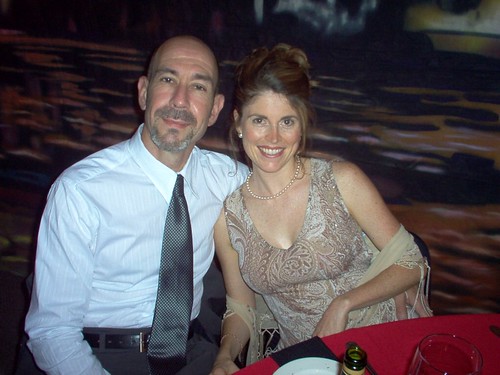
Although it was a work do, I had been looking forward to an opportunity to get dressed up and get out and have some fun. I had also heard that last year's event was excellent and much fun was had. We arrived at the Lagoon Beach Hotel and mingled in the foyer with the few people I knew, sipping apple martinis and watching the rest of the people arriving. Everybody was looking very smart and glamourous and one or two of the ladies looked simply spectacular, in what I am sure were very expensive designer gowns. One grey/dusty blue dress in particular was breath-taking.

The theme was Las Vegas and Gambling, and the hotel function room was decorated very nicely, with pretty lights behind organza hangings and big candelabras on each table, at the back of the room they had set up black-jack & roulette tables and some leather couches for relaxing on.

The event was an extended dinner with talks, awards and entertainment between each course. There were singers and dancers (a bit cheesy for our liking, but I am sure the other people enjoyed them). Tim Plewman spoke during dessert. He covered a fair portion of his 'Defending the Caveman' material, but he was funny none-the-less. Especially because he was a bit tipsy ;)

The dinner was very nice and was beautifully presented on large white plates (I didn't even think of taking photos of it - damn!). We had an italian tomatoe and mozzarella ball salad in a potato basket for starters. A delicious burned orange sorbet. A succulent and tasty, but simply flavoured pan-fried chicken breast on mushroom risotto for main. Finally a baked gooseberry pudding with a brandy-snap basket filled with cinnamon ice cream for dessert.

After dinner we were looking forward to the tempo kicking up a few notches and a party mood setting in, but the band who had been playing some pretty good and diverse music and singing some very good covers (some songs sounded just like the originals) suddenly decided to kill the party. Although many people got up and headed for the dance floor and tried their darnedest to dance at least a thrid of the crowd left within 30 minutes. We even down a few tequillas to help us along... but after several Shirley Bassey(!?) and other 15-30 year old songs almost all gave up. Who knows what they were thinking?

So at around 12 Richard and I decided to hit the road and look for something more fun to do. We ended up in good old Claremont and back at Stones, where we had fun a month or so ago after Ten PIn Bowling. It is not exactly a high-class establishment, and we were rather over dressed for it, but the music was good . :) We hit the dance floor immediately and had a really fun time. Most of the crowd were young (probably 25 and under) and almost all were coloured (shades of brown) and all very fun and friendly. Despite feeling bit conspicous in long revealing and sparkly dress, I felt very comfortable there. We danced up a storm for well over an hour. Each time Richard went of to buy drinks, or go to the loo etc I would find one or 2 young guys suddenly dancing suspiciously close to me (tee hee), they would back off again as Richard returned. It was kind of fun, and nice not to feel old and on the shelf ;)

When we were done dancing we decided to play pool. So there was Richard in his smartest suit and me in floor length sparkly dress leaning over the pool table. Again, I was much better than I expected, or than I ever used to be. Yay me! I am sure if Richard really tired and was feeling competitive he would totally slaughter me, but as it was I was able to keep pace with him. Astounding! :)

We eventually decided it was time to go home at close to 3am...

The kids were angelic on Sunday morning. They got up quietly, spoke quietly and managed to get themselves breakfast, watch TV and then even go back through to the spare room and load up an internet game and play it together. taking turns nicely, and remaining quiet and co-operative. Thank-you boys! In fact the loudest thing was the voice on the game singing 'Your turn!'. Not only that, but their bedroom, the kitchen and loung were all neat and tidy too.

So we were able to wake up late and slowly and linger in bed for a long time before conceding that the day really had started and we had better get up and at it. I actually felt fine, but I phoned my friend and told her that I would definately not be joining her at the gym, as I was going to be having a day of REST. We agreed to rather meet at her house for coffee. So this we did, and then we headed over the mountain to the Noordhoek Village Fair, which has evolved from a tiny hippy gathering to a big community-carnival type event. We ate, drank, relaxed and played with friends and milled around and looked and weird and wonderful things which were for sale.

After that I was finished and it was time to head home to end a long and fun filled week-end. This morning we were nanny-less, and all exhausted. But we managed to all get up and co-operative and help each other to get ready and out of the house on time. I already can't wait till bed time tonight.

-----

Richard leaves for his pan-continental trip, of almost 4 weeks long, early on Friday morning! I am not looking forward to it, but I am sure we will manage, and I am going to have less personal freedom in that time, but that might result in me having to do less, and therefore relaxing a bit more...? I hope Richard has a good time meeting all the Canonical/Ubuntu folk.

In 2 weeks the boys and I fly to JHB for another function. The boys will stay with my father, and we will celebrate Griffin's birthday there with my family.

Friday, 27 October 2006

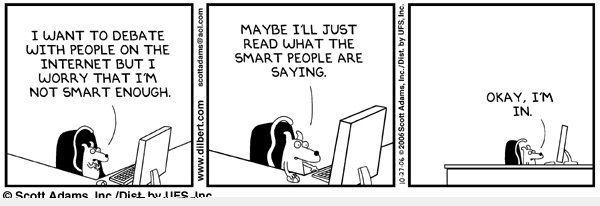
Jane reading Scott Adams' blog...

Scott Adams (yes, he of Dilbert fame) has become one of the people I most respect recently. I think he has a brilliant mind and his caustic and irreverent and often very humorous take on most topics is simply illuminating and usually hillarious, and right on the mark. I also enjoy reading the debate which rages in the comments in his blog much of which is moronic and totally missing the point, but there are some other very bright people mixed in there too.

He is extremly intelligent, but not only that he is also a hard working and applies his mind fully. I really admire him, and totally GET him. (ok maybe I am just into nerds!).

His blog has become staple reading of mine, and I have subscribed to his daily Dilbert strip for years now, as well as his Dogbert's New Ruling Class (DNRC) newsletter.

So this is me reading his blog...


P.S. Scott Adams is watching me! It is the only explanation for why his Dilbert strips mirror my life. If I start a new job, his strip is a about a new person starting. If I abuse coffee his strip is about coffee abuse. If I start debating on his blog... you get the picture. So today I had popcorn for lunch, for the first time in AGES, and what is the Dilbert strip about... you guessed it popcorn! Cue creepy music now....

Thursday, 26 October 2006

What's your dictionary definition?

Now for something a bit lighter (but don't forget to reduce your carbon emissions!)...

How would you be described in the dictionary? Mine is eerily accurate :)


Jane --

[noun]:

A level headed person who always makes the wrong decision

'How will you be defined in the dictionary?'

or is it...? I gave it another shot.


Jane --

[adjective]:

Smelling like turnips at all times

'How will you be defined in the dictionary?'


What do turnips smell like? *sniff* *sniff*

An Inconvenient Truth

I have just now returned from seeing Al Gore's movie 'An Inconvenient Truth', and WOW. It is horrifying!

My first impressions are that if I thought I hated the States, and more specifically the Bush family before, I loathe them now! However that is not really the aim of the film at all, so I am going to try hard not to focus on that side effect of watching the film, too much. **

I am still reeling from the facts revealed, and am determined not to, as he says in the film, 'Go from denial straight to despair, missing that all important step in between which is to DO something'.

Although there is much more I can, and will be doing, I am proud to report that all light bulbs in our household are already low energy bulbs, and I have also recently replaced my car with a very fuel efficient, and low emission model. I use water sparingly, and make a point not to be wasteful in general as much as possible. I also re-use shopping bags multiple times. I am going to try to build further on this and do more recycling, as we only do paper recycling through the school at the moment, and will try to use less processed and over-packaged goods. It is important for everyone to start doing their small part, because each small contribution can and does help. Additionally, each of the things you can do to help save the planet ALSO save you money. I mean d'oh how hard can making that choice really be...?

Admittedly, I did not know very much about Al Gore before, but I am hugely impressed by him. He is a warm, intelligent, articulate and principled man - all of which clearly counted against him in his election campaign. Although it is not directly stated, or even really implied, in the film, it is clear to me that the election results the year he ran were totally rigged. The debacle with the Florida recount was to swing the vote, as they couldn't possibly have a free-thinking principled environmentalist running the country(!) in place of the village-idiot puppet oil-heir.

The main website for An Inconvenient Truth is here. Go take a look at it.

The Brittish version is here.

For reviews of this movie look here:

"Will likely make you admire Al Gore a little more than you already do, worry about the planet a lot more than you already do, and finally, leave you with as many questions as when you started. -Michael Booth"

"I can't think of another movie in which the display of a graph elicited gasps of horror, but when the red lines showing the increasing rates of carbon-dioxide emissions and the corresponding rise in temperatures come on screen, the effect is jolting and chilling. Photographs of receding ice fields and glaciers — consequences of climate change that have already taken place — are as disturbing as speculative maps of submerged coastlines. The news of increased hurricane activity and warming oceans is all the more alarming for being delivered in Mr. Gore's matter-of-fact, scholarly tone.

He speaks of the need to reduce carbon-dioxide emissions as a "moral imperative," and most people who see this movie will do so out of a sense of duty, which seems to me entirely appropriate. Luckily, it happens to be a well-made documentary, edited crisply enough to keep it from feeling like 90 minutes of C-Span and shaped to give Mr. Gore's argument a real sense of drama. As unsettling as it can be, it is also intellectually exhilarating, and, like any good piece of pedagogy, whets the appetite for further study. This is not everything you need to know about global warming: that's the point. But it is a good place to start, and to continue, a process of education that could hardly be more urgent. "An Inconvenient Truth" is a necessary film. - By A. O. SCOTT"

Another good review is here.

I urge everyone to see this movie. It should literally change your life. Honestly.

** I can NOT understand why the good people in the States do not DO something about the insanity they are living in and with. Perhaps they are like the frog analogy Al Gore uses, and are just too complacent to jump, even though the water is starting to boil around them. (See the movie to understand this)

Wednesday, 25 October 2006

For those that understand Afrikaans

and South Africa's obsession with Rugby...

Van der Merwe goes to London to watch the Boks take on the Poms at Twickenham.

Whilst in London , he walks around, gaping and staring at everything. So much so that he walks smack bang into a fire hydrant which hits him so hard on the family jewels that they burst.

He gets rushed to hospital where the doctors tell him they have to remove his testicles.
Van goes beserk: he bites and snarls at every one and he won't let anybody within 10 metres of him.

Eventually they find a South African doctor in the hospital and get him to talk to Van.
He walks up to Van and tells him "Hey Van, die ouens moet jou ballas uithaal."
Van replies "O, okay, ek dog die bliksems wil my test tickets vat."

Tuesday, 24 October 2006

Yoga Practice

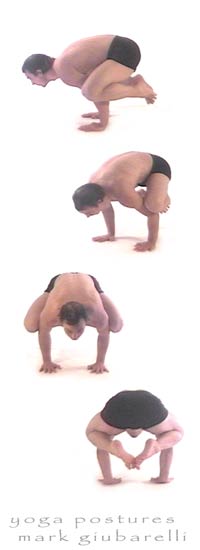
Following on from the last post detailing the what and why of yoga, this one deals more with the what and how, so here are some links to some of the Asanas and Pranayama exercises which are practised.

Yoga Postures (Asanas):
The practice of Yoga Exercises or Asanas can improve your health, increase your resistance, and develop your mental awareness.

You can find a nice easy to follow guide of the basic yoga postures here

These include:
Yoga Exercises - Warm-Up Poses Warm-Up Poses
In general, warming up depends on the Yoga Style that you practice. This section covers some Warm-Up exercises that you can do prior to a Yoga class or session.

Yoga Exercises - Standing Poses Standing Poses
Learn how to practice the different Standing Poses - Triangle Pose, Hands to Feet, Standing Side Stretch Pose, Stand Spread Leg Forward Fold, Warrior Pose, Tree Pose, and Sun Salutation.

Yoga Exercises - Seated Poses Seated Poses
There are poses which can be done while sitting. In this section, know how to do the various Seated Poses such as Spread Leg Forward Fold, Hero Pose, Seated Forward Bend, and Child Pose.

Yoga Exercises - Twist Yoga Poses Twist Yoga Poses
Aside from strengthening the back, the Half-Spinal Twist and Sage Twist are Yoga Poses which tone and massage the abdominal area and improve digestion.

Yoga Exercises - Supine Poses Supine Poses
This section covers several Yoga Poses which are done in supine (lying face up) position - Leg Reclining Lunge, Locust Pose, Leg Pulls, Leg Raises, and Wind Relieving Pose.

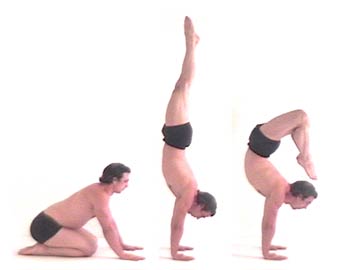
Yoga Exercises - Inverted Postures and Balance Poses Inverted Postures and Balance Poses
Shoulderstand, Headstand, and Plough can help increase circulation, stimulate the brain, enhance glandular system functioning, and relieve pressure on the abdominal organs.

Yoga Exercises - Backbends Backbends
Backbends are Yoga Poses which promote flexibility in the spine and strengthen the arms, legs, and abdomen. In this section, know how to practice Backbends.

Yoga Exercises - Finishing Poses Finishing Poses
The Corpse Pose or Savasana and the Final Corpse are Yoga Poses which are usually practiced as final relaxation at the end of a Yoga Session.

Yoga Breathing (Pranayama):
When the Breath wanders, the mind is unsteady, but when the Breath is still, so is the mind still." - Hatha Yoga Pradipika

Breathing is life. It is one of our most vital functions. One of the Five Principles of Yoga is Pranayama or Breathing Exercise which promotes proper breathing. In a Yogic point of view, proper breathing is to bring more oxygen to the blood and to the brain, and to control Prana or the vital life energy. Pranayama also goes hand in hand with the Asanas. The union of these two Yogic Principles is considered as the highest form of purification and self-discipline, covering both mind and body.

There is more on Pranayama practice and techniques here.

There is also a nice section detailing health and yoga applications for various conditions and ailments here.

As well as a specific section dealing with respiratory issues (Dave read that).

Finally....

What does Om mean?
Om is a mantra, or vibration, that is traditionally chanted at the beginning and end of yoga sessions. It is said to be the sound of the universe. What does that mean?

Somehow the ancient yogis knew what scientists today are telling us - that the entire universe is moving. Nothing is ever solid or still. Everything that exists pulsates, creating a rhythmic vibration that the ancient yogis acknowledged with the sound of Om. We may not always be aware of this sound in our daily lives, but we can hear it in the rustling of the autumn leaves, the waves on the shore, the inside of a seashell.

Chanting Om allows us to recognize our experience as a reflection of how the whole universe moves - the setting sun, the rising moon, the ebb and flow of the tides, the beating of our hearts. As we chant Om, it takes us for a ride on this universal movement, through our breath, our awareness, and our physical energy, and we begin to sense a bigger connection that is both uplifting and soothing.

... and that should be more than enough information for you to digest about yoga!

OM - my god.

Ok as requested here's an article on yoga.

As usual wikipedia has a lot of info to offer, so if you want to know more about the origins and history behind it, that is a good place to start.

There are various styles of yoga and the development of yoga followed various paths, so there are many similarities and differences in the various styles as they have evolved. The first recorded images of yoga are about 6-7 thousand years old. The first written accounts are from 1500 - 1200 BCE**, but it is understood that the traditions had already been orally transmitted for about a thousand years before that. The first description of the principles and goals of yoga is to be found in the Upanisads, thought to have been composed between 700 and 300 BCE.

- Look here for info on Yoga it links to various other topics including the roots of yoga, Patanjali and the branches of yoga etc.
- Look here for Hatha Yoga - The Hatha Yoga of Swatmarama and his contemporaries differs from the Raja Yoga of Patanjali in that it focuses on shatkarma, the purification of the physical as leading to the purification of the mind (ha) and prana, or vital energy (tha). The Raja Yoga posited by Patanjali begins with a purification of the mind (yamas) and spirit (niyamas), then comes to the body via asana (body postures) and pranayama (breath). Hatha Yoga is what most people associate with the word "Yoga" and is mainly practiced for mental, physical health, and vitality outside of India.
- Look here for Ashtanga Yoga - Raja yoga is also known as Ashtanga Yoga. The term Ashtanga means eight limbs, thus Ashtanga Yoga refers to the eight limbs of yoga. It is the classical Indian system of Hindu philosophy and practice (composed by Patanjali perhaps ca. 200 BCE).

Another good source of info is ABC of Yoga from which much of the info below was taken.

What most people refer to as simply "yoga" is actually Hatha Yoga.

Hatha Yoga is a system of yoga introduced by Yogi Swatmarama, a yogic sage in the 15th century in India. This particular system of yoga is the most popular one, and it is from which several other Styles of Yoga originated including Power Yoga, Bikram Yoga, Ashtanga Yoga, and Kundalini Yoga. The word "hatha" comes from the Sanskrit terms "ha" meaning "sun" and "tha" meaning "moon". Thus, Hatha Yoga is known as the branch of Yoga that unites pairs of opposites referring to the positive (sun) and negative (moon) currents in the system. It concentrates on the third (Asana or postures) and fourth (Pranayama or breathing) steps in the Eight Limbs of Yoga.

Hatha Yoga tries to achieve balance between body and mind, as well as attempts to free the more subtle spiritual elements of the mind through physical poses or Asanas, Breathing Techniques or Pranayama, and Meditation.

* Asanas are various body positions (postures or poses) designed to improve health and remove diseases in the physical, causal, and subtle bodies. The word "asana" is Sanskrit for "seat", which refers not only to the physical position of the body but also to the position of the body in relation to divinity. They were originally meant for Meditation, as the postures can make you feel relaxed for a long period of time. The regular practice of Asanas will grant the practitioner muscle flexibility and bone strength, as well as non-physical rewards such as the development of will power, concentration, and self-withdrawal.

* Pranayama is derived from the words "prana" (life-force or energy source) and "ayama" (to control). It is the science of breath control. This is an important part of Hatha Yoga because the yogis of old times believed that the secret to controlling one's mind can be unlocked by controlling one's breath. The practice of Pranayama can also help unleash the dormant energies inside our body.

The practice of Hatha Yoga can help you recognize your hidden physical and mental potentials. Through the continued performance of Asanas, you will gain flexibility and strength, and learn to be more relaxed under otherwise stressful situations. Hatha Yoga's Relaxation Exercises will open the energy channels, which in turn allows spiritual energy to flow freely. Some Asanas also massage and tone your internal organs, helping to prevent diseases such as diabetes, arthritis, and hypertension. They also bring balance to internal and glandular functions. Pranayama, on the other hand, can help manage asthma and bronchitis.

Hatha Yoga can also help you cope with stress, relieve tension, and deal with anxiety and depression. More importantly, it will help you put your mind in a focused state to prepare for Meditation and, eventually, the search for enlightenment.

The practice of Yoga does not only focus on physical postures to improve the body, but deals with all the aspects of our being and our lives. C.E., Patanjali who is considered the father of Modern Yoga compiled 195 aphorisms which are called the Yoga Sutra. In the Yoga Sutra, he described the eight aspects of a Yogic Lifestyle and called it the Eight Limbs of Yoga. The limbs are practical guides to a person's personal development to achieve the harmony of the mind, the body and the spirit which leads to Samadhi or enlightenment.

More on The Eight Limbs of Yoga (Hatha focuses on limbs 3 and 4, but does not proclude following the others as well, but those would largely require that you immerse yourself into a yogic lifestyle - although we can all benefit from trying to follow the principles as best we can in our regular daily lives.)

* Yamas
Yama is your attitude towards others and the world around you. There are five Yamas:

1. Ahimsa or non-violence. This Yama does not only mean not doing harm to others in thought and in deed, but also to practice acts of kindness to other creatures and to one's own self.
2. Satya or truthfulness. Satya is the Yama that is about living a truthful life without doing harm to others. To practice Satya, one must think before he speaks and consider the consequence of his action. If the truth could harm others, it might be better to keep silent.
3. Asteya or non-stealing. This Yama is not only concerned about the non-stealing of material objects but also the stealing of other's ideas and other forms of possession. Using power for selfish motives or telling someone else about confidential information you had been entrusted with is against Asteya.
4. Bramacharya or non-lust. Bramacharya means to move toward the essential truth or to achieve self-control, abstinence or moderation especially regarding to sexual activity. It is about not giving in to our ego's excessive desires or taking nothing in excess.
5. Aparigraha or non-possessiveness. This Yama is about living a life free from greed or taking only what is necessary and do not take advantage of someone or of a situation. It is about using our powers correctly and appropriately and not exploiting others.

* Niyamas
Niyama is how you treat yourself or your attitude towards yourself. The following are the five Niyamas:


1. Sauca or cleanliness. This Niyama is concerned on both the outer and inner cleanliness. The practice of pranayamas, asanas and Yogic cleansing practices to detoxify and cleanse the physical body are necessary to achieve inner cleanliness. The mind must also be kept clean or pure. Outer cleanliness, on the other hand, means to keep an clean environment or surroundings.
2. Santosha or contentment. Santosha is to practice humility, modesty and finding contentment with what you have and who you are.
3. Tapas or austerity. This Niyama refers to keeping the body in good condition. Tapas is practiced through disciplining the body, speech and mind like eating only when hungry and maintaining a good posture.
4. Svadhyaya or study of the sacred text and of one's self. This involved studying one's self, self-inquiry and self-examination and other things that can help you get to know yourself more. As your knowledge about yourself grows deeper, so is your connection to the higher power and your union with all things.
5. Isvarapranidhama or living with an awareness of the Divine. This Niyama encourages us to let go of our false sense of control and to connect to the Divine or that which gives us the sense of wholeness and sacredness.

* Asanas or Physical Poses
The Asanas are designed to free our mind and body from tension and stress. It relaxes, rejuvenates, and energizes the body and aims to bring the body and the mind into a harmonious union. Asanas should be done with comfort, ease, alertness and steadiness, achieving a balance between ease and effort.

* Pranayama or Breathing Exercises
Pranayama is the control of breath. The breath is regulated and controlled through the practice of breathing exercises. The duration of inhalation, retention, and exhalation of breath is regulated with the aim of strengthening and cleansing the nervous system and increasing a person's source of life energy. Pranayama practice also makes the mind calmer and more focused.

* Prathayara or Withdrawal of the Senses
This occurs during meditation, pranayama or asana wherein you are so focused and immersed on your Yoga, Meditation or Breathing Pose that you become unaware of outside situations. Your focus becomes inward and you are no longer distracted by outside events.

* Dharana or Concentration
Dharana is training the mind to focus without any distraction. To achieve this, you can focus your mind into an object at a time. This can also serve as a preparation for meditation.

* Dhyana or Meditation
Meditation is the practice by which there is constant observation of the mind. It means focusing the mind on one point, stilling the mind in order to perceive the Self. It is an uninterrupted flow of concentration aimed to heighten one's awareness and oneness with the universe. It is also an important tool to achieve mental clarity and Health.

* Samadhi or Enlightenment
This is the ultimate goal of the Eight Limbs of Yoga. It is characterized by the state of ecstasy and the feeling that you and the universe are one. It is a state of peace and completion, awareness and compassion with detachment.

The practice of Yoga does not only deal with developing the body but also covers all the aspects of a person's life as stated in the Eight Limbs of Yoga. It is concerned about the physical, mental and spiritual well-being of an individual as well as his environment and relationship with other creatures. Real practice of these eight principles leads to deeper self-knowledge, love and respect towards other people and creatures, cleaner environment, healthy diet, and union with the Divine.

-------------------------------

Not All Yoga Is Created Equal

You say Ashtanga, I say Kundalini. What's the difference? Use this guide to find the right yoga for you.

Are You a Sweat-Hog or a Swami?

Not sure which style of yoga is right for your personality and body type? This quiz will enlighten you.

--------------------------------
More on the different styles:
Hatha Yoga: Hatha Yoga Styles

Hatha Yoga is the branch of Yoga that focuses on the physical well-being of a person and sees the body as the driver of the spirit. Each of these styles of yoga use Asanas or poses to balance the body, mind and spirit. However, some emphasise the alignment of the body while others concentrate on co-ordinating the movement and breath. Ten of the most common styles of Hatha Yoga are listed below: Ashtanga Yoga (as modernised in the West - remember it was previously stated that this is part of Rama Yoga which focuses on the MIND first, which it originally was, now howvere it has become to be known as POWER yoga and has a strongly exercise and sweat focus), Iyengar Yoga, Viniyoga, Bikram Yoga, Kundalini Yoga, Ananda Yoga, Anusara Yoga, Jivamukti Yoga, Sivananda Yoga and Svaroopa Yoga.

Ashtanga Yoga
Ashtanga was developed by K. Pattabhi Jois. It is a very physically demanding form of yoga often known as 'power yoga'. The system of Ashtanga is based on six series of increasing difficulty. It involves performing a challenging sequence of poses with Ujjayi Breathing and vinyasas which will produce intense internal heat and a purifying sweat that detoxifies muscles and organs.

Iyengar Yoga
Iyengar Yoga was named after B.K.S. Iyengar. This style of yoga focuses on detail and precise alignment of postures. Iyengar yogis use yoga props such as blocks and belts. The props are meant to help achieve the best possible pose and provide support to minimize the risk of injury. Iyengar poses are held longer and repeated several times.
Viniyoga
Vini yoga roots from Sri. T. Krishnamacharya's practices, teacher of well-known contemporary masters K. Pattabhi Jois and B.K.S. Iyengar. Yogis practice modified poses to meet their specific needs. This style of yoga promotes healing and flexibility.

Bikram Yoga
Bikram Choudhury founded this style of yoga. It is typically practiced in a room with a temperature of up to 100 degrees. Scientifically, this warms and stretches muscles, ligaments and tendons in the order in which they should be stretched. Therefore it is a very sweaty practice. Bikram is a series of 26 Asanas accompanied by Kapalabhati Breath, the 'breath of fire'.

Kundalini Yoga
In this style of yoga, the spine is regarded as a snake. It was brought to the West by Yogi Bhajan in the late 1960s. The practice concentrates on releasing the Kundalini energy which is found at the base of the spine. Kundalini Yoga includes a series of classic poses and chanting. The emphasis however, is not on the Asana but on the chanting. Spiritual transformation is the main aim of practice.

Ananda Yoga
Ananda Yoga is a gentle practice. Swami Kriyananda developed this classical style of Hatha yoga that uses Asana and Pranayama to engage energies of the chakras.

Anusara Yoga
Anusara is a combination of Hatha yoga and biochemical principles. It is a very modern style of yoga developed by John Friend. Practice is described as heart-oriented and spiritually inspiring and concentrates on outer and inner body alignment. Different students' abilities and limitations are deeply respected.

Jivamukti Yoga
Perhaps the latest form of Hatha yoga, Jivamukti was created by David Life and Sharon Gannon in 1984. Like Ashtanga yoga, practice is vigorously physical but more intellectually stimulating. There is a great deal of emphasis on the educational aspect of the practice and students are taught how the philosophies of yoga came about.

Sivananda Yoga
Sivananda was developed by Vishnu-devananda. Practice consists of Pranayama and classic Asanas - 12 basic poses. Diet and positive thinking are also heavily emphasised on in this style of yoga.

Svaroopa Yoga
Rama Berch founded Svaroopa Yoga. It introduces alternative ways of doing familiar poses with deep emphasis on the spine. It aims to open the spine by developing gentle movement from the tailbone right through to the top of the spine. It is another style of yoga which is not at all athletic and more involved in consciousness and healing properties.

A good general Yoga FAQ can be found here
The Hatha yoga I do has a good balance between Western pragmatism and Eastern philosphy and spirituality. We incorporate aspects of all the various Hatha styles, and even pilates movements at times too, this results in a good overall balance which is accessible to the tree-hugging vegan, right through to busy business person. It caters for the beginner right through to advanced students and makes for a nice wholistic and centering ritual each week.

So there you go, use it, don't use it...
__________________________________

** BCE stands for "Before the common era." It is expected to eventually replace BC, which means "Before Christ," or "Before the Messiah ". BC and BCE are also identical in value.
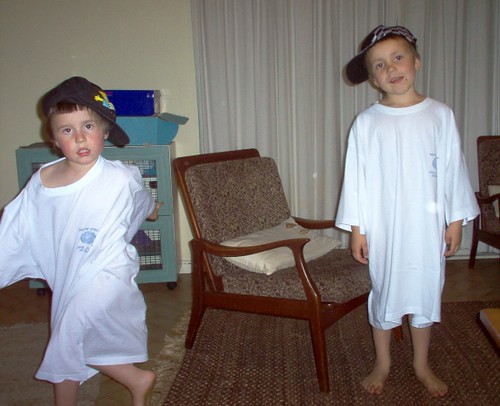
Supermodel or Ordinary Girl?

Lindy sent this to me.

Makes you think....

1) Billboard/Magazine models are pretty ordinary

and conversely

2) Ordinary people could also be Billboard/Magazine models.